The Flemish Environment Agency, in collaboration with ARCHE Consulting, has investigated the presence and distribution of Ultra-Short Chain (USC) PFAS in Flanders
Exploratory study on Ultra-Short Chain PFAS in Flanders
Insights from a monitoring-based study on the occurrence of ultra-short chain PFAS in Flanders
The Flemish Environment Agency (Vlaamse Milieumaatschappij - VMM) and ARCHE Consulting have investigated the presence and distribution of Ultra-Short Chain (USC) PFAS in Flanders across the aquatic compartment (wastewater, surface water, and groundwater).
USC-PFAS are a specific sub-group of the broader PFAS family (Per- and polyfluoroalkyl substances). Because of their smaller molecular size (≤ 3 carbon atoms), they are highly mobile in the aquatic environment.

The most well-known compound within this group is trifluoroacetic acid (TFA). These substances are highly persistent and are both intentionally used in industrial applications and formed through the degradation of other fluorinated substances, such as pesticides, refrigerants, and pharmaceuticals.
Ultra-Short Chain PFAS in Flanders
The Flemish Environment Agency has set up two monitoring campaigns (in 2024 and 2025) to assess the presence and distribution of USC-PFAS in Flanders. In a first monitoring campaign, wastewater and surface water were sampled across different sectors and motives in Flanders. In a follow-up campaign, ground water and surface waters in rural area across Flanders were sampled for USC-PFAS alongside PFAS-pesticides (i.e., pesticidal substances that have a potential to lead to the formation of PFAS-substances due to the presence of C-CF3 groups in their molecular structure).
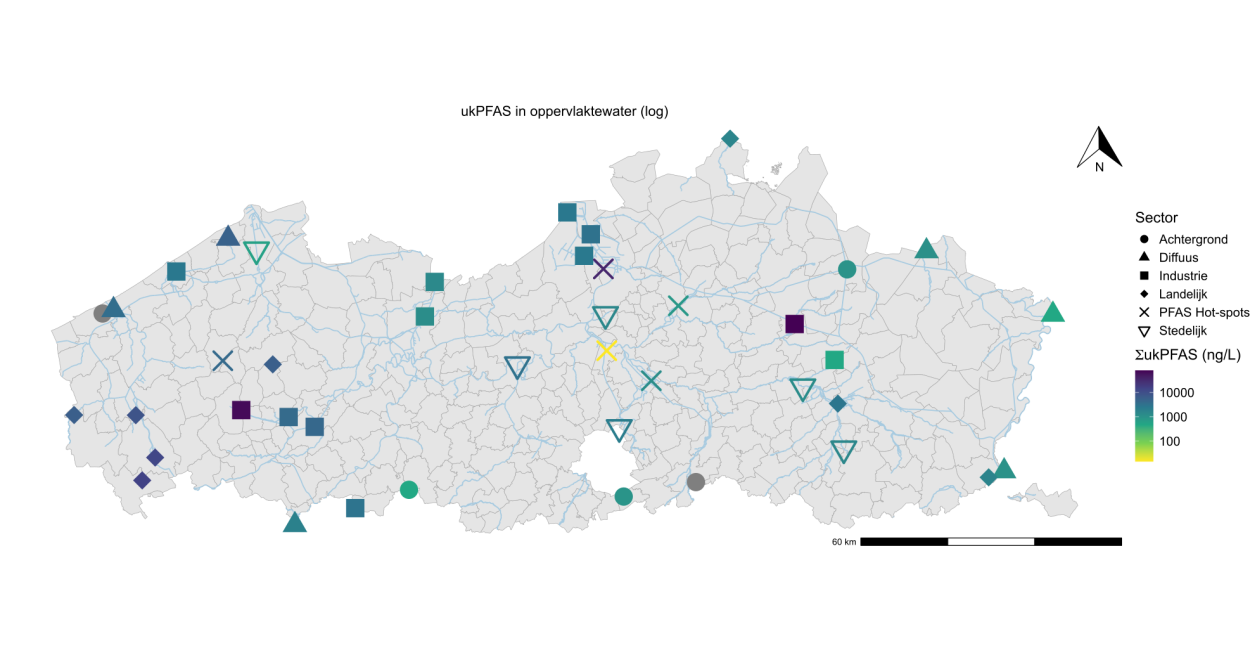
Map of the concentration of the sum of USC-PFAS in surface waters across in Flanders (log-based scale, units in nanograms per liter). The different symbols represent sampling points from different motives (pristine background areas, diffuse areas, industrial areas, agricultural/rural areas, PFAS hot-spots, and urban areas).
Read the full study report (in Dutch) on the website of the Flanders Environment Agency here:
Read our earlier study on the widespread distribution of PFAS across Flanders (in Dutch):
For more information on this study, contact Nathalie Briels or Karel Vlaeminck.